 Bundle & Save
 Camping Chair
 Hammocks
 Tote Bag
 Cooler & Coffee Cup
 Beach Towel
 Hooded Towels
 Picnic Blankets
 Bags & Backpacks
 Cooler Backpack
 Outdoor Puffy Blankets
 Tarp, Bug Net & Accessories
How to Hang a Hammock Anywhere (Even Without Trees!)

Picture this: You've finally scored the perfect camping spot. The view is incredible, the weather is perfect, and you're ready to relax in your hammock. There's just one small problem… there are no trees! Or the trees are too far apart. Or they're too close together. Or they're the wrong height. You get the idea.
The good news is you don't need two perfectly spaced trees to enjoy hammock life. With a bit of creativity and the right setup, you can hang a hammock almost anywhere. Whether you're dealing with a treeless beach, a rocky outcrop, or just a backyard that's severely lacking in the tree department, we've got you covered.
At Nakie, we've spent years perfecting hammocks that are built to last a lifetime. And in that time, we've learned every trick in the book for hanging them in less-than-ideal conditions. Let's break down how to hang a hammock anywhere – yes, even without trees.
Read more: The best hammocks for camping in Australia

What You Need to Hang a Hammock
Before we dive into creative solutions, let's cover the fundamentals. To hang a hammock, you need:
-
Two anchor points that are roughly 3-4.5 meters apart. The exact distance depends on your hammock length and how much sag you like, but this range works for most setups.
-
Weight-bearing capacity. Your anchor points need to support your weight plus the dynamic force of getting in and out. For most people, that means each anchor should handle at least 90-135 kg safely.
-
Good clearance. Ideally, your anchor points should be 1.2-1.8 meters off the ground. Higher is fine, but you'll just need longer straps or rope.
-
The right suspension system. Straps with multiple loops (like the adjustable straps that come with Nakie hammocks) make setup easy. They give you 12 different positions to choose from, so you can get the perfect hang even when your anchor points aren't ideal.
The perfect hammock hang follows the "30-degree rule": when you're lying in the hammock, the suspension straps should make roughly a 30-degree angle from the anchor point. This creates a good balance between comfort and stress on the anchor points. Too flat and it's uncomfortable; too steep and you're putting unnecessary strain on everything.
Read more: Why Nakie’s hammocks make the best gift for adventurers

How to Hang a Hammock Without Trees
There are plenty of creative ways to hang a hammock without trees, and the easiest, safest solution is investing in a hammock stand.
A good portable hammock stand gives you the freedom to set up literally anywhere: your backyard, the beach, a park, a parking lot if you're feeling weird about it. They're especially good for:
-
Locations with zero natural anchor points
-
Situations where you're not allowed to attach to existing structures
-
Setting up on different surfaces (grass, sand, concrete, gravel)
-
Creating a permanent hammock spot without drilling into anything
The downside? They're bulkier to transport than just a hammock and straps. But if you're car camping or setting up at home, the convenience is hard to beat.
If a hammock stand isn’t your vibe, here are some other ideas. But again, always test your setup before fully committing your weight. Give your anchor points a solid shake, lower yourself in slowly, and make sure everything feels secure.
If you have any doubt about whether something will hold, find a different anchor point. The time to discover your setup isn't safe is during testing – not when you're already relaxing three feet off the ground. Your safety is always more important than the perfect hang spot.
Posts and Poles
Sturdy posts are hammock heaven. Look for fence posts, porch columns, light poles, signposts (where allowed)... you get the picture.
The key is making sure they're sturdy. Give any post a solid shake before trusting it with your weight. If it wobbles, keep looking. Wooden fence posts that have been in the ground for years are usually solid, but that decorative garden post from the hardware store? Maybe not.
Wrap your tree straps around the post just like you would a tree. If the post has a flat surface (like a square porch column), you might need to wrap it a couple of times to prevent slipping. The carabiners that come with Nakie hammocks make it easy to clip in once your straps are positioned.
Rocks and Boulders
This is where things get really creative. Large boulders and rock formations can make excellent anchor points if you use them correctly.
For rocks with good shape, you can wrap straps around them directly – look for rocks with a natural "waist" or narrowing that'll keep your straps from sliding off. Think of it like you're putting a belt on the rock.
If you've got flat-topped boulders, you can use the "rock anchor" method: Place a sturdy stick or piece of driftwood on top of the rock, run your strap over it, and use the rock's weight to hold everything in place. This works best with heavier rocks (obviously) and when you're pulling at an angle that presses down on the anchor rather than trying to lift it off.

Car / Van
Your car can be an anchor point in a pinch. This works especially well in the outback or at beach camping spots where trees are scarce.
Wrap your strap around the tow hook or trailer hitch (not the bumper, which often isn't strong enough). If you're using your car as one anchor point and a tree as the other, make sure your car is in park with the parking brake on. You don't want your relaxation session turning into an impromptu vehicle relocation.
Just be aware that getting in and out of a hammock creates a rocking motion. If you're a restless hammock sleeper, your car alarm might have opinions about that.

Buildings & Structures
Balconies, decks, pergolas, and gazebos can all work as hammock anchor points. Attach to support beams or posts (but never railings, which usually aren't designed to take that kind of load).
If you're on a covered porch, you might be able to use heavy-duty eye bolts screwed into solid beams. This is more of a permanent installation, but it's worth it if you're setting up a regular hammock spot at home.
Advanced Techniques for Tricky Situations
Need help troubleshooting some difficult hammock-hanging situations? Try out the below.
Trees That Are Too Far Apart
If your trees are more than 5.5 metres apart, you have options:
-
Use a ridgeline. Run a length of strong rope or webbing between the trees, then hang your hammock from that. This also works great for setting up a rain tarp.
-
Add extension straps or rope to your existing suspension system. Just make sure whatever you're adding is rated for the weight and that your knots are solid.
Trees That Are Too Close Together
When trees are closer than 3 metres:
-
Wrap your straps higher up the trunk. This increases the distance and changes the angle.
-
Use shorter straps or wrap your existing straps multiple times around each tree to take up slack.
-
Accept more sag. A deeper hammock curve isn't ideal for sleeping, but it works fine for lounging.
Uneven Anchor Points
One tree taller than the other? One post and one rock at different heights? No problem.
-
Adjust your strap positions to compensate. If one anchor is higher, use a lower loop on that side and a higher loop on the other side.
This is where those 12 adjustable positions on Nakie straps really shine (you can fine-tune until it's level).
Windy or Exposed Locations
Beach and coastal hammocking comes with its own challenges:
-
Hang lower to the ground. This reduces wind resistance and makes your setup more stable.
-
Use your rain tarp as a windbreak by setting it up on the windward side.
-
If you're using a hammock stand, stake it down or weight the legs with rocks or gear bags.
-
Consider a bug net not just for insects, but as an extra layer of wind protection.

Common Mistakes (And How to Avoid Them)
Trusting Sketchy Anchors
That dead tree branch? The rusty pole? The fence that's already leaning? None of these are good ideas. If you have even a small doubt, find something else. A hammock fail makes for a funny story later, but a painful reality in the moment.
Hanging Too High
Unless you're experienced with your setup, keep your butt no more than 45cm off the ground when you're sitting in the hammock. Falls happen, and falling from a hammock is usually more embarrassing than dangerous (unless you've set up six feet in the air).
Forgetting About Swing Radius
Your hammock moves. Make sure there's nothing you'll smack into when you swing (no brands, no sharp rocks, no fire pits, no other campers trying to enjoy nature).
Ignoring the Weather
Wind changes everything. What feels stable in calm conditions might be sketchy when a breeze picks up. Always factor in potential weather changes, especially if you're planning to sleep in your hammock.
No Trees? No Problem!
Not having perfect trees isn't a deal-breaker for hammock life. With a bit of creativity and the right approach, you can hang a hammock almost anywhere. The key is thinking beyond trees and looking for any two solid anchor points at roughly the right distance and height.
At Nakie, we build our hammocks to be versatile, durable, and packable because we know you're not always going to find that picture-perfect setup with two trees exactly where you need them. Whether you're hanging between fence posts in your backyard, setting up on rocks at the coast, or using a stand on the beach, the goal is the same: get outside, strip back to nature, and enjoy the simple pleasure of swaying gently in the fresh air.
So next time you show up somewhere and think "there's nowhere to hang my hammock," take another look. The perfect setup might just require a little outside-the-box thinking. And if all else fails? There's always the hammock stand option. No shame in taking the easy route to relaxation.
FIND YOUR PERFECT NAKIE HAMMOCK
FAQs
How much weight can a hammock hold?
Most quality hammocks, including Nakie hammocks, are rated 135-225 kg. Nakie hammocks specifically can hold up to 225kg and are designed to comfortably fit two people. Just remember the weight limit depends on both the hammock fabric and your anchor points and suspension system being equally strong.
Can you sleep in a hammock every night?
Yeah – why not!? Plenty of people sleep in hammocks full-time and swear it's better for their back. The key is getting the right sleeping position (lie diagonally rather than straight down the center). This flattens out the hammock and reduces the "banana" curve.
What's the best knot for hanging a hammock?
Honestly? Skip the knots. Use tree straps with loops like the ones that come with Nakie hammocks. They're faster, easier to adjust, safer, and won't damage trees. If you have to use rope, a bowline knot is reliable and easy to untie. But seriously, get straps – they're worth it.
How do I stay warm in a hammock?
Heat loss happens from below because your sleeping bag gets compressed underneath you. Use an underquilt, sleeping pad, or the Nakie puffy blanket (made from recycled plastic with 600-fill power insulation) to insulate from below. On top, a regular sleeping bag or blanket works fine. Setting up a rain tarp also helps trap warm air around you.
What do I do if it rains?
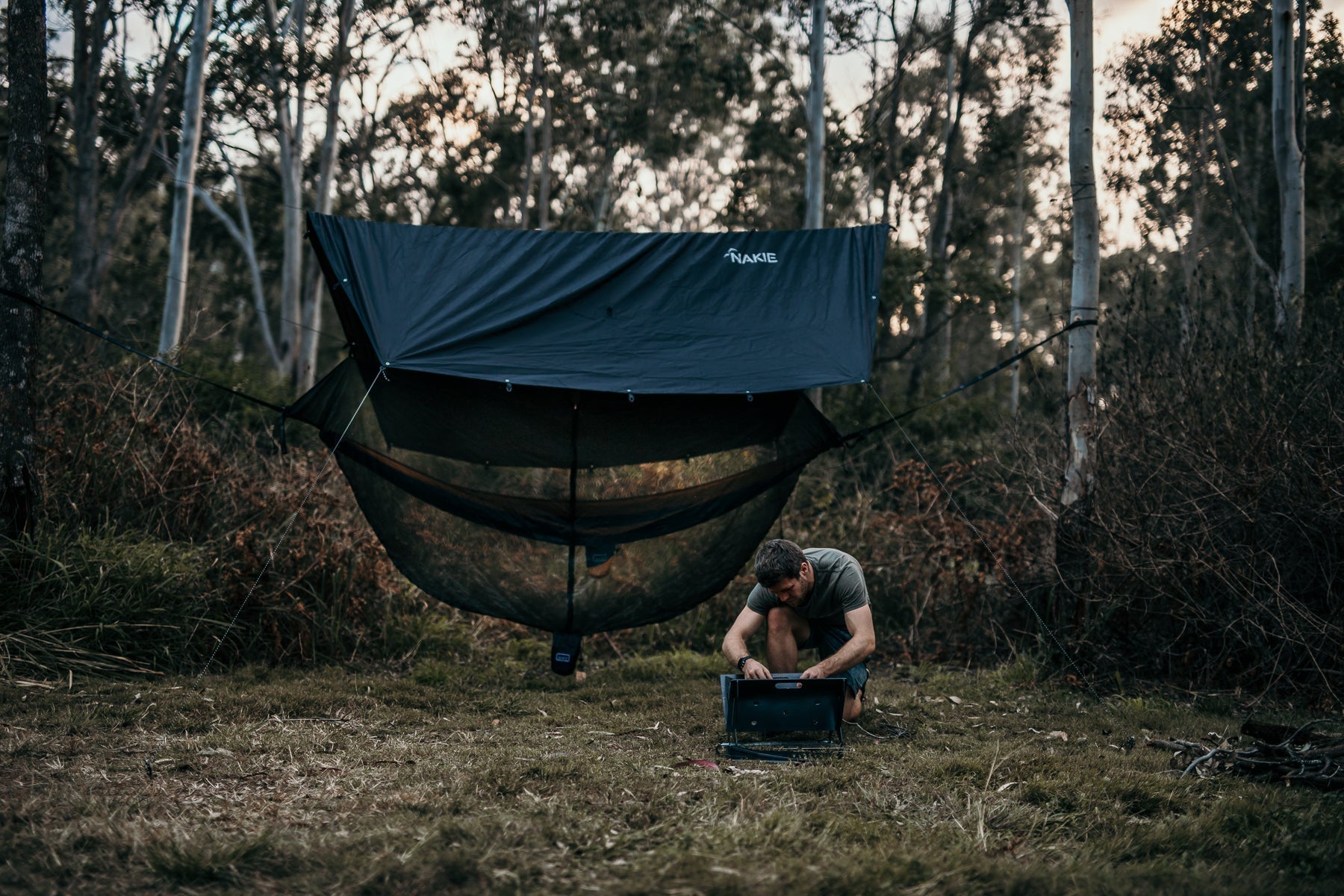
Set up a rain tarp! The Nakie 3m x 3m rain tarp is made from 3000mm PU coated waterproof ripstop recycled polyester and includes a ridgeline and guy lines. String it up above your hammock at an angle to shed water. As long as your tarp is properly positioned and you're not touching the sides, you'll stay completely dry.
How tight should a hammock be?
Not as tight as you’d think. A good hammock should have a nice sag to it (aim for about a 30-degree angle from your anchor points to where you're lying). If your hammock is pulled tight like a guitar string, it's going to be uncomfortable and put way too much stress on your anchor points. You want it to look a bit droopy when empty.